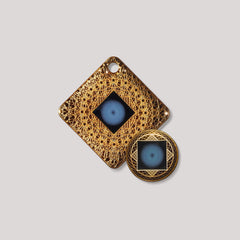
If you keep a phone in your pocket or hold it against your ear, an EMF protection sticker sounds like a simple way to keep using it. Does one work? Start with what you want it to change. A phone can emit radio waves, tissue can absorb some of that energy, and the body can respond. Each question calls for a different experiment.
For example, in Volkow and colleagues’ human PET study, 47 volunteers underwent scans with a cellphone switched on and with it switched off. After a 50-minute exposure, the researchers found higher glucose use in the brain region closest to the active antenna. That finding makes a biological response worth investigating. To find out what an accessory contributes, a study also needs a comparison with and without the accessory.
What happened when researchers tested phone stickers?
In Ghana, Osei and colleagues tested 11 anti-radiation stickers on two phones in a shielded enclosure. None reduced the radiofrequency emissions in their tests. An earlier experiment by Oliver, Chou and Balzano put nine adhesive shields on the same phone and measured energy absorption in a model head. The peak absorption did not change significantly with any shield.
That gives anyone shopping for an EMF blocker a concrete test to ask for. Aires takes a different engineering approach. Its etched silicon resonator is designed to interact with the field around a connected device. Below you can see the modeled field pattern, then follow the experiments that measured biological responses with Aires technology present.
What does a sticker claim to do?
“Blocks radiation,” “changes the field” and “improves a biological measurement” are different claims. A test should measure the outcome being advertised. Adhesive is an attachment method; it tells you very little about the engineering underneath.
| Claim | Evidence to look for |
|---|---|
| Reduces RF reaching a particular location | Measurements with and without the product, identifying frequency, phone mode, orientation and measurement position. |
| Reduces energy absorbed by the body | A relevant absorption measurement, such as SAR testing under a defined protocol; a nearby meter reading answers a different question. |
| Changes electromagnetic-field characteristics | A defined physical model and measurements of the field quantity being claimed, with the tested resonator identified. |
| Changes a biological response | A study of the named endpoint, showing the participants or species, device, exposure conditions and comparison results. |
Can a small, passive object interact with an electromagnetic field?
Yes. Conductive materials, antennas and resonant structures can interact with fields without a battery. Size, geometry, material and frequency influence that interaction. The absence of a battery is therefore not evidence that a device is inert. Equally, an interaction by itself does not tell you its magnitude or its biological outcome: those are questions for measurement.
Aires uses a silicon wafer with an etched, self-affine pattern of ring-shaped grooves. In the Springer-published computer-simulation study, Lukyanov, Kopyltsov and Serov modeled the surface response to incident electromagnetic radiation. Their model produced a stable, multifrequency electric-field distribution over the resonator surface. Read the original paper and the study summary for the geometry, model and results.
Why a phone test needs more than one meter reading
A phone adjusts its transmission during use. A conductive accessory can also alter antenna behavior. 3GPP’s NR power-control specification, section 7 includes path-loss estimates and network commands in the power-control process. A before-and-after test needs comparable network conditions, phone activity, orientation and measurement positions.
ARPANSA’s exposure guidance explains that accessories can reduce exposure in some fixed-power tests while also affecting the phone’s automatic power control. This is why a material sample, a signal-bar display or one point on a handheld meter cannot substitute for testing the assembled product under its claimed conditions.
What the FTC’s patch cases actually established
In 2003, the FTC announced settlements involving WaveScrambler and WaveGuard patches and their radiation-protection advertising. The cases concerned those products and unsupported performance claims. The original FTC announcement is the source to consult; it is not a test of the Aires resonator. The practical lesson is to inspect the evidence for the specific product and claim.
The Aires research you can examine
Published biological measurements
Dyuzhikova and colleagues’ 2019 Ecological Genetics paper studied rat bone-marrow chromosome aberrations during a 2.4 GHz Wi-Fi protocol. With six Aires resonators in the experimental arrangement, the reported frequency in the low-threshold rat line fell from 9.8% with the router alone to 2.7% with the router and resonators. The protocol used four days of six-hour exposure; responses varied across rat lines. Open the original study or the biological-research guide to examine the full comparison.
Human EEG research
The 2024 Lifetune ONE EEG and HRV report describes favorable brain-connectivity observations and autonomic trends during its protocol. Its principal alpha EEG and HRV comparisons were not statistically significant. The source-linked study record identifies the analyzed groups, measured outcomes and report versions, so the findings can be read in their original context.
In Sysoev and Budko’s 2026 paper, the researchers reported that EEG measures returned toward baseline after initial activation with the resonator and that coherence increased over seven days of use. Read the study summary and original journal issue for the mobile-phone protocol and results.
Expert peer review
PACE’s Andrew Michrowski reviewed research across EEG, HRV, blood, aqueous systems and resonator modeling. The publication and expert-review hub links seven original assessments. For a concrete example, compare the PACE expert peer review of Rybina and Alexandrov’s EEG research with its original assessment PDF and underlying report.
Five questions to ask before buying
- What is the device? Look for a described material, structure and model.
- What is the exact claim? Identify whether it concerns shielding, a field measurement or a biological endpoint.
- Where is the original evidence? Open the report, not just a marketing graphic.
- Was this device tested? Check its generation and the conditions used.
- Can you follow the result? The study should identify what was compared and what the researchers found.
Frequently asked questions
Is Aires Lifetune a sticker?
Some Aires products attach to personal devices. The functional component is an engineered semiconductor resonator. The etched structure and its research are the relevant basis for comparison.
Does a working phone prove that an accessory has no effect?
No. Wireless connections can tolerate changes in signal level, and phones adapt their transmission. Continued connectivity is not a complete shielding or field-interaction test.
Can I compare every stick-on EMF product using Aires studies?
Each study identifies the device it tested. Aires research should be matched to the named Aires technology and protocol, rather than transferred to unrelated adhesive products.
Where should I start with the Aires evidence?
Begin with the research overview, then follow the physical or biological question to the study summary and original document.
Choose your next step
For cases, pouches and room materials, use our EMF-blocker comparison. To see how a real product test compares with the laboratory research, read our comparison of the Linus Tech Tips chamber test and the Vilnius experiment. To connect the evidence to personal-device options, visit the product-evidence guide and explore Aires personal-device products.
Updated November 4, 2026 · Josh, Aires. Research findings and expert assessments are credited to their original authors; original documents are linked above.