
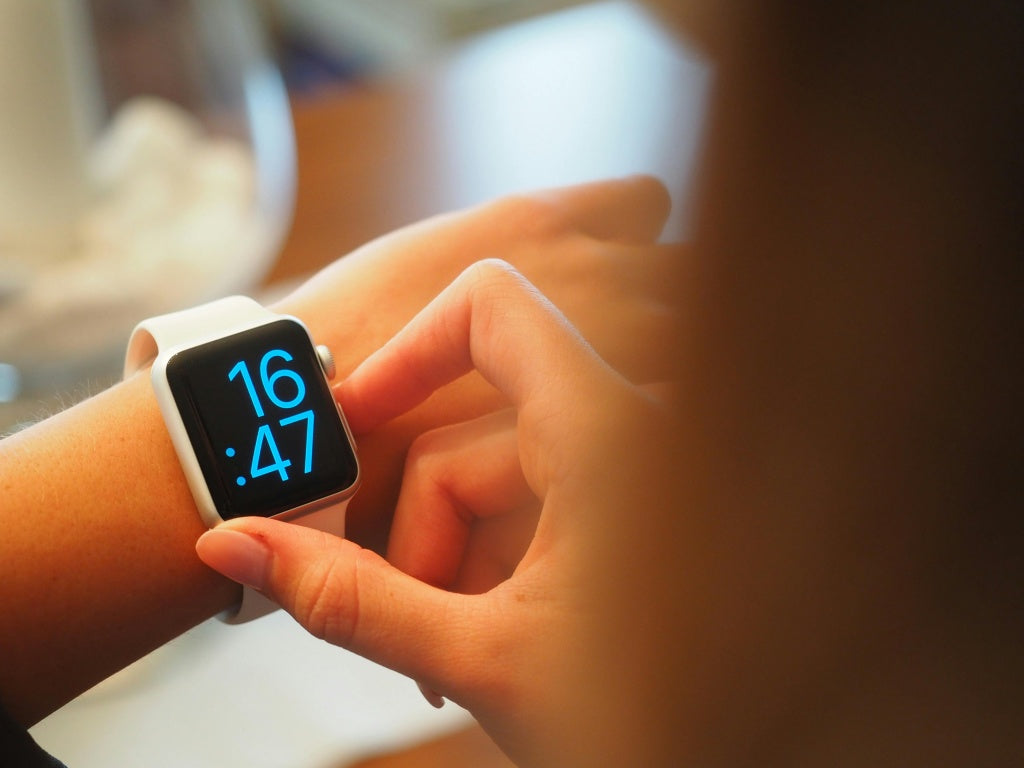
Do Smartwatches Emit Radiation? What Research Shows About Wearable EMF
Yes -- smartwatches emit radiofrequency (RF) radiation continuously. Most modern smartwatches maintain an active Bluetooth connection (2.4 GHz) to your phone at all times, and models with cellular capability add LTE transmission on top of that. The Apple Watch Series 9 lists a peak SAR of 1.09 W/kg for wrist use; the Samsung Galaxy Watch6 lists 0.97 W/kg. These are within FCC limits. The more specific question -- what does continuous skin-contact EMF exposure mean over years of daily wear -- is what researchers and wellness-focused users are actually asking.
What Smartwatches Actually Emit
A smartwatch worn 24/7 maintains constant close-contact RF exposure that a phone doesn't. Your phone spends most of its time in your pocket or on a desk, at distance. A smartwatch spends most of its time pressed against your wrist -- 2-4mm of skin separation, 24 hours a day if you use sleep tracking.
Bluetooth (2.4 GHz): Active whenever the watch is paired with your phone, which is almost always. Power output is low -- Class 2 Bluetooth at roughly 1-2.5 mW -- but continuous.
WiFi (2.4 GHz and 5 GHz): Present on many smartwatch models for direct app downloads and streaming without Bluetooth relay.
LTE/5G cellular: Present on cellular-capable models. When the watch is away from your phone (workout without phone), it transmits at cellular power levels to maintain connectivity. This is the highest power output mode of any smartwatch function.
Optical sensors: Heart rate, SpO2, and ECG sensors emit green/red/infrared LED light into the wrist, not RF. These don't contribute to EMF exposure.
The FCC's SAR limits were established in 1996 based on thermal effects from short-duration exposure. The continuous, years-long skin-contact exposure profile of a 24/7 worn device was not part of that framework's design.
What Research Shows About Wearable-Range Frequencies
The most directly applicable independent research on biological responses to 2.4 GHz-range RF exposure -- the primary frequency of smartwatch Bluetooth -- comes from a 33-year longitudinal program at the Pavlov Institute of Physiology, Russian Academy of Sciences (IFRAN). The program used WiFi-frequency wireless device fields (2.4 GHz range) in its exposure protocols across a 5-stage rat study.
Dyuzhikova et al. (2019, Ecological Genetics) published Stage I findings: chromosomal aberrations in bone marrow cells at 9.8% in the wireless device EMF group, dropping to 2.7% with the Aires resonator modifying the field's coherence structure (p<0.001). The mechanism studied -- continuous close-proximity wireless device exposure -- is more analogous to wearable exposure than to phone-in-pocket use, since the source is worn against the body.
The Military Medical Academy (VMA, Russia) conducted a 2024 EEG study with 24 human subjects examining CNS bioelectric activity under wireless device RF exposure conditions, with and without the Lifetune ONE present. The study documented normalized brain wave patterns in the Aires group. The mechanism -- structural field modulation via fractal diffraction -- operates on the coherence properties of the EMF field regardless of whether the source is a phone or a wearable device.
Vilnius Gediminas Technical University (VGTU, Lithuania) confirmed measurable field characteristic changes at 2.4 GHz in its 3-phase spectrum analysis (2016-2018), the specific frequency band that smartwatch Bluetooth uses continuously.
The Continuous Exposure Problem
The exposure profile of a smartwatch is different in kind, not just degree, from other wireless devices. A phone is typically in a bag or pocket at distance for large portions of the day. A smartwatch is in direct skin contact throughout activity, rest, and sleep. Researchers who have raised questions about long-term RF exposure have specifically highlighted proximity and duration as the variables that compound over time.
There are three practical reduction strategies that don't require abandoning the watch:
1. Disable cellular when near your phone. When Bluetooth is active, the cellular radio typically goes dormant. This keeps the watch on its lowest-power mode during most use. Only when separated from your phone does cellular kick in.
2. Use airplane mode during sleep if you don't use sleep tracking. This eliminates all RF emissions for 7-9 hours of close-contact sleep exposure with no functional cost.
3. Charge the watch off the wrist. Smartwatches are designed to charge nightly. Off-wrist charging is the default state for most users. During charging, the watch continues processing -- keeping it off the wrist eliminates the proximity during those hours.
For those who want sleep tracking and overnight heart rate monitoring -- where removing the watch defeats the purpose -- structural field modulation via an Aires resonator addresses the field's coherence properties without requiring the device to be removed or turned off. The Lifetune ONE (for phone proximity) or a personal resonator worn alongside the smartwatch modifies the coherence structure of the Bluetooth field being emitted, operating at the field level rather than the device level. See the personal protection collection, the EEG and brain research cluster, and the animal models research cluster for the supporting evidence base.
Security and Mental Health: The Rest of the Case for Reconsidering Smartwatches
The EMF question is one of three substantive criticisms of always-on smartwatch use that have grown in recent years.
Security: Smartwatches store or relay health data, GPS location, payment credentials, and phone access. Security researchers have documented vulnerabilities in multiple smartwatch models that allow location tracking and data access. Children's smartwatches in particular have shown GPS and communication vulnerabilities.
Mental health: The always-on notification model creates a constant interrupt stream. Technology journalists and clinical researchers have documented increased stress, anxiety, and difficulty with presence in heavy smartwatch users -- particularly around activity ring/goal monitoring that turns movement into a continuous performance assessment.
Whether the solution is removing the watch, modifying usage patterns, or taking a field-level approach to the EMF component, the starting point is understanding what the watch actually emits and what research shows about those emissions. The Aires research overview covers the full independent evidence base.
Frequently Asked Questions About Smartwatch Radiation
Do smartwatches emit radiation?
Yes. Smartwatches emit RF radiation from Bluetooth (2.4 GHz, always active when paired), WiFi, and cellular radios. The Apple Watch Series 9 lists a peak SAR of 1.09 W/kg; Samsung Galaxy Watch6 lists 0.97 W/kg -- both within FCC limits.
Is smartwatch EMF dangerous?
Within current safety standards for thermal effects at short durations, yes. Long-term biological effects of continuous skin-contact 2.4 GHz exposure over years of daily wear are understudied. The IFRAN 33-year research program, using 2.4 GHz-range wireless device fields, documented measurable biological responses (chromosomal, neurological) in exposed groups vs. controls.
How can I reduce EMF from my smartwatch?
Disable cellular when near your phone (Bluetooth-only is lowest-power). Use airplane mode during sleep if you don't need sleep tracking. Charge off-wrist nightly. For users keeping sleep tracking active, structural field modulation via an Aires resonator modifies field coherence without requiring device removal.
What frequency does smartwatch Bluetooth use?
Standard Bluetooth uses 2.4 GHz -- the same frequency studied in the IFRAN rat program and confirmed in the VGTU spectrum analysis (2016-2018), which documented measurable field characteristic changes at 2.4 GHz with the Aires resonator present.
Is wearing a smartwatch 24/7 a different EMF risk than phone use?
Yes, the profiles differ: a phone is typically at distance for most of the day, while a smartwatch maintains direct skin contact throughout waking and sleeping hours. Continuous skin-contact Bluetooth emission represents a different exposure dynamic than intermittent phone-in-pocket use.