
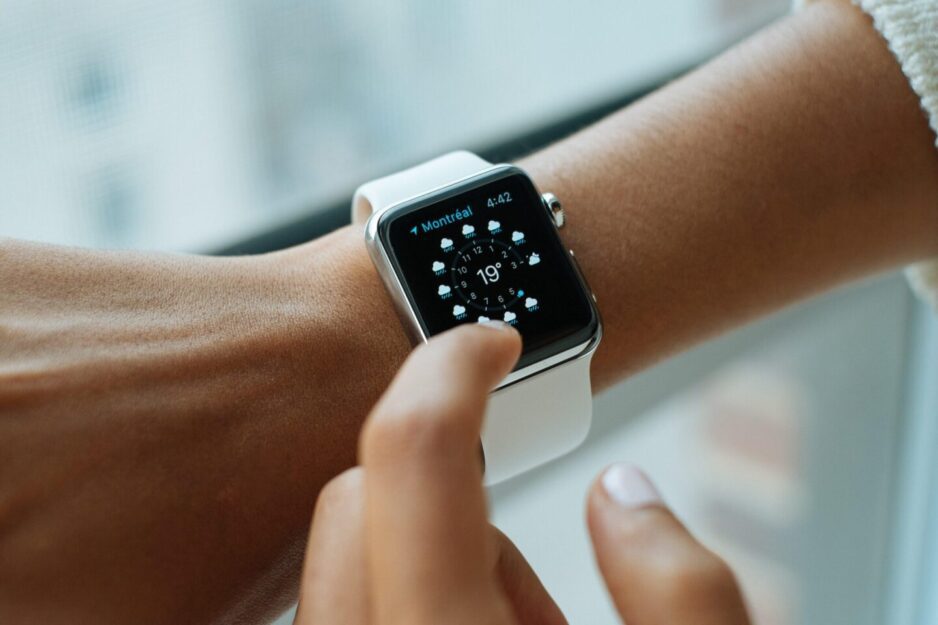
A fitness tracker is supposed to help you feel and perform better. If wearing one brings wrist discomfort, unusual warmth or a change in sleep, it makes sense to investigate. If you are comparing Fitbit, Garmin, Apple Watch or a simpler pedometer, it also makes sense to ask what each device transmits—and whether you need those connections throughout the day.
Wireless fitness trackers emit radiofrequency EMF when they transmit. Aires believes the evidence of EMF-related biological disruption warrants proactive attention to the environment we live and train in. Choosing a wearable should include that question alongside comfort, useful measurements and training goals.
Bluetooth, GPS and heart-rate sensors do different jobs
Bluetooth uses the 2.4 GHz band to communicate with phones, headphones and other equipment. A connected tracker exchanges information over time; “connected all day” does not mean it transmits continuously at its maximum power. The actual activity depends on the device and its functions.
GPS receives satellite signals. An optical heart-rate sensor uses light. Neither should be counted as another Bluetooth transmitter simply because it appears on a feature list. Uploading those measurements or sharing heart rate with another device is a separate wireless function.
| Feature | Question to ask | Why it matters |
|---|---|---|
| Bluetooth | Can I switch it off on the tracker itself? | Disconnecting the phone app and disabling the tracker’s radio are different actions. |
| Wi-Fi or cellular | Does this exact model have these radios? | A standalone smartwatch can have more connection options than a basic activity band. |
| GPS | Is it built in or supplied by a connected phone? | Connected GPS makes the phone and its connection part of the workout setup. |
| Optical sensors | Which measurements use skin contact and light? | Keep contact, pressure and sensor operation distinct from RF communication. |
| Offline recording | What can it record without a wireless connection? | You may be able to record an activity first and sync later. |
| Simple pedometer | Does the specification confirm there is no wireless transmitter? | A device without a radio removes that particular RF source; it does not characterize your whole environment. |
Compare documented controls, not a brand-level harm score
Garmin example: the vívomove Sport owner’s manual documents a Bluetooth on/off setting, computer syncing by USB and separate heart-rate broadcasting controls. This is useful evidence about that model’s operation. Check the manual for any other model you are considering.
Fitbit example: Google’s GPS guide distinguishes built-in and connected GPS. Charge 5 and Charge 6 offer dynamic GPS options; Inspire 3 uses phone GPS. A GPS label alone does not tell you whether a phone connection is involved.
Apple Watch example: Airplane Mode leaves Bluetooth active by default while disabling Wi-Fi and cellular. Check the Bluetooth setting separately. Muting notifications is not the same as switching off a radio.
These differences help you choose a routine you can control. They do not provide a clinical ranking of which brand is most harmful. That would require comparative biological studies with defined models, settings and wear conditions.
Why biological research belongs in a wearable decision
A 2024 Australian crossover pilot studied 12 adults during active and sham 2.45 GHz baby-monitor exposure. Reported sleep quality worsened and some sleep-EEG measures changed during exposure; HRV and actigraphy did not change significantly. This was a baby-monitor experiment, not a fitness-tracker trial.
In a different human experiment, Volkow and colleagues measured increased regional brain glucose metabolism near a phone antenna after 50 minutes of exposure in 47 adults. That demonstrates a physiological response under the study conditions; it did not measure disease or compare wearable brands.
For Aires, such findings are a reason to take biological interaction seriously. A low-power label does not answer every question about a device worn against the body for hours. The relevant questions include its signal, timing, placement and the biological outcome being investigated.
If the tracker feels wrong, investigate the actual experience
Record the model, band, fit, workout, duration and active connections. Sweat, friction, material sensitivity, heat and wireless activity are different possibilities. Remove a tracker that causes pain, irritation or uncomfortable heat; persistent or worsening symptoms deserve assessment.
For sleep, compare a consistent routine with and without wearing the tracker. A change is useful information, but removing the device changes several factors at once. Keep a simple record of how you feel as well as any app score. See the smartwatch symptoms and settings guide for a fuller investigation.
Where Aires fits: measure biology and improve the environment
Your wearable sits within a larger environment of phones, Wi-Fi, headphones and other equipment. Aires develops resonators designed to organize electromagnetic interactions toward more stable, biologically supportive conditions while technology remains usable.
In Datova’s 2013 original study, 12 of 13 volunteers had a lower HRV-derived regulatory-system stress index after 20 minutes with a previous-generation Aires device. The researcher interpreted the results as reduced regulatory strain and improved adaptive capacity. The study summary and PACE expert peer review explain that work.
That is a measured human endpoint, not a claim to treat a tracker reaction. Explore the broader Aires research program and current personal-environment products alongside the practical choices you can make about your wearable.
Start with the features you need. Verify the controls. Take your experience seriously. Then consider the electromagnetic environment as part of the health and performance picture you bought the tracker to understand.
Updated November 2, 2026 · Josh, Aires. Original findings are attributed and linked to their researchers and publications.