
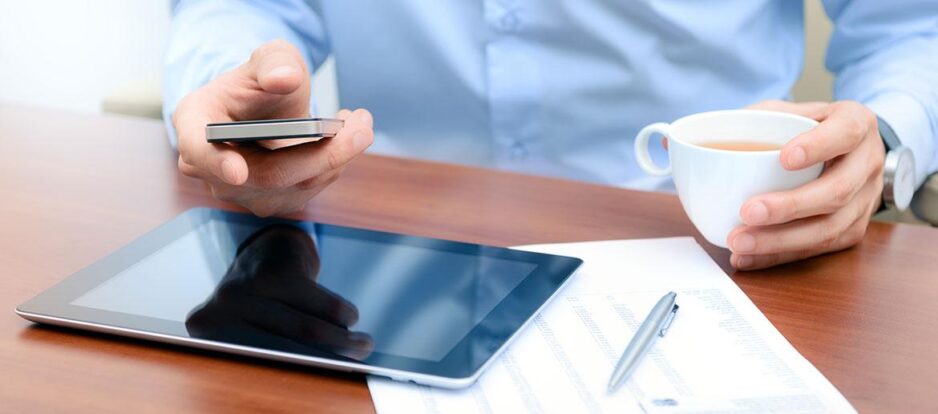
Electronic devices can affect health through several pathways, from evening light that changes sleep timing to the physical demands of using a screen for hours. Electromagnetic exposure belongs in that conversation too: researchers have measured physiological responses and adverse cellular effects under specific RF exposures.
Aires’ position is clear. That body of research gives people a serious reason to examine the electromagnetic environment and act proactively. The task is to make the evidence understandable, identify the conditions behind each finding and connect that knowledge to choices people can make in a connected life.
What does “radiation from electronics” actually include?
A laptop or phone can involve more than one exposure. Wi-Fi, Bluetooth and cellular radios transmit RF signals. Displays emit visible light. Power systems and wiring produce electric and magnetic fields at other frequencies, and devices can become warm during use.
These distinctions are useful because they connect a question to an appropriate study or action. Turning down screen brightness changes the light; it does not switch off Wi-Fi. Plugging in Ethernet can replace a network link, but you still need to check the radio settings. A single EMF-meter reading cannot describe every part of this environment.
Original research gives us concrete findings to examine
Wireless laptop exposure and reproductive cells
In Avendaño and colleagues’ study, paired sperm samples from 29 donors were incubated for four hours with or without exposure to a Wi-Fi-connected laptop. Exposed samples had lower progressive motility and more DNA fragmentation; the proportion of dead sperm did not differ significantly. This was an experiment on cells outside the body, not a measurement of pregnancy outcomes in laptop users.
The adverse cellular findings are a substantive reason to investigate exposure around reproductive health. The experiment’s design also identifies the next question: how those observations relate to real-world conditions and outcomes. Keeping a laptop on a desk is an immediate, practical way to change its proximity to your body.
Phone-related RF and human brain physiology
Huber and colleagues’ human work found EEG changes after pulsed RF exposure that were not produced by the unpulsed condition. The study makes signal timing relevant alongside intensity. Different signals and protocols need to be examined on their own terms.
This is why “non-ionizing” or “low power” is not a complete biological explanation. Those terms describe properties of an exposure. Experiments that measure living systems answer a different part of the question.
Evening screen light and sleep
In Chang and colleagues’ crossover study, 12 adults read a light-emitting e-book or a printed book for about four hours before bedtime across five evenings per condition. The light-emitting condition suppressed melatonin, delayed the circadian clock and reduced next-morning alertness. The measured pathway was optical exposure, rather than a test of Wi-Fi.
There are therefore several reasons to examine a device routine. Accurate source distinctions let the research strengthen your decisions instead of collapsing every effect into one explanation.
Think about the whole environment
A phone, earbuds, watch, router and smart-home equipment may operate around you throughout a day. Their signals vary with location, connection, activity and time. Aires uses the environmental perspective because your interaction with technology extends beyond one product or one moment.
Start with an inventory: what is near your body, what stays active overnight and what functions you actually need? Then identify the exposure you want to change. Multiple sources make characterization more involved; their number alone does not quantify a biological outcome.
Make practical changes without giving up useful technology
- Change close-contact habits. Put laptops on a work surface and give active phones a convenient place away from prolonged body contact.
- Choose connections deliberately. Try wired audio or networking where practical and verify which wireless functions remain active.
- Review the evening routine. Consider the light and timing of screen use separately from wireless settings.
- Follow your experience. If discomfort recurs with a device, pause use, record the pattern and seek appropriate assessment when symptoms persist.
- Improve the room. Review router placement, charging locations and the functions left running while you sleep.
For a particular device, go deeper into Apple Watch connections or AirPods and Bluetooth research. For the workday, use our workplace guide and desk-symptom investigation.
How Aires connects environmental design to biological testing
Aires develops resonator structures intended to organize electromagnetic interactions toward conditions that support biological function. The research program moves between mathematical models, physical measurements and biological experiments. Each level contributes evidence about a different part of that design thesis.
The 2026 Sysoev–Budko journal paper reports EEG recovery following initial activation and increased coherence after seven days in its mobile-phone-and-Aires protocol. Datova’s HRV report recorded a lower regulatory-system stress index in 12 of 13 volunteers after 20 minutes with a previous-generation Aires device. These are specific biological measurements of the intervention, with the methods and results available in the originals.
The broader EMF literature explains why the environmental question matters; Aires research examines what happens when its technology is introduced. Follow the research-development story and evidence overview to connect those roles.
If you began with “EMF blocker” or “radiation protection for electronics,” our blocking and field-modulation guide explains the methods. From there, compare current Aires options with the sources and routines you want to address. Understanding the biology and the environment gives you a stronger basis for action now.
Updated November 4, 2026 · Josh, Aires. Original research is linked and attributed to its authors.