
What makes the Aires chip fundamentally different from conventional processors?
Conventional digital processors are active devices: they require an external power source, encode data as discrete binary states, and process information sequentially — one instruction at a time. This architecture works well for computation, but it is structurally incompatible with continuous real-world electromagnetic signals. To process an analog signal, a conventional processor must first convert it to digital form, introducing unavoidable approximation errors and latency. At high frequencies, this becomes a meaningful constraint.
The Aires Lifetune resonator is not a digital processor. It is a passive analog diffraction processor — a silicon wafer etched with a self-affine fractal topology that interacts directly with incident electromagnetic fields through the physics of diffraction. It requires no external power source, no binary encoding, and no sequential processing. Its operation is continuous, simultaneous, and inherent to its physical structure.
Nanotech Fabrication

Fractal Diffraction Lattice
16 Vectors

28 Vectors

32 Vectors

The core of the Aires resonator is a specialized analog processor that uses the chip's annular diffraction grating to simultaneously perform the forward and reverse Fourier transform — defining the full spectrum of possible solutions in a single physical interaction. Diffraction through the grating decomposes a complex electromagnetic signal into a continuous spectrum. Critically, the spectrum is continuous — it completely occupies the entire frequency range, introducing no distortion and losing no information. The incoming electromagnetic impulse is not altered in power; it is transformed in structural coherence — from linear coherence to fractal coherence.
This is the fundamental distinction. A digital processor converts real signals into approximate discrete representations and processes them sequentially. The Aires diffraction lattice processes the actual electromagnetic field directly, simultaneously, and without approximation — through the inherent physics of wave interference in a structured grating. The ideal implementation is a three-dimensional coherent structure, but even the two-dimensional fractal projection implemented in the Lifetune resonator is more direct and lossless than conventional signal-processing approaches.
The Aires resonator is a silicon wafer — standard in the microelectronics industry — superimposed with a special fractal topology that satisfies the condition:

The circuit is created from rings using a special algorithm in the form of a self-affine matrix.

To understand how the resonator operates, we can use well-known concepts from diffraction grating physics. In the simplest case, a diffraction grating is a series of evenly-separated slits in a material that is opaque to radiation.
According to the Huygens-Fresnel principle, when parallel beams of energy hit a grating with spacing b, it produces diffraction — deviation from straight-line propagation near obstructions, such as when an electromagnetic impulse passes through an opening or slit. The opening or slit becomes a source of secondary waves propagating in all directions. Because these waves are caused by the same initial wave, they are coherent — correlated in phase and frequency.


When the slits are separated at a regular interval, there is regular superposition of the secondary waves — interference.
Interference produces a regular alternation of maximum and minimum intensity in the propagation of secondary waves. The position of these extrema can be calculated using:

Because the greatest distance between maxima in the intersections of the resonator's circular slits is approximately 5 µm, the chip functions as a diffraction grating across a broad electromagnetic spectrum — the interference produced coherently modulates the field structure of incident radiation.
The fractal matrix acts as a universal Fourier filter — inducing a space-time, amplitude-frequency, fractal-coherent transformation of electromagnetic radiation across a broad spectrum of frequencies.
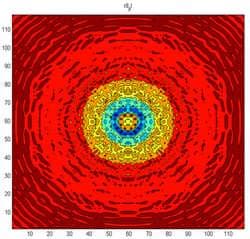


The fractal lattice complexity — measured by the number of axes of fractalization — scales across Lifetune product tiers. Greater complexity extends the operating range and increases the breadth of fractal-coherent transformation across the frequency spectrum. Each individual slit creates a phase shift in the surface wave and acts as a high-frequency waveguide for two colliding wave functions.


When the intensity of an energy stream moving along a ring reaches the threshold value, an opposing soliton is generated. As only the phases of these wave functions coincide, a stable, stationary field is created in the form of a spatial fractal structure — a fractal-coherent field hologram. Within each circular segment of the circuit is a radial oscillation (center-periphery-center) in the form of radially compressing and expanding waves with a stable spectrogram. In lenticular areas where the circular waveguides intersect, a linearly-dashed spectrogram occurs, oriented against the process's optical axis — promoting interference with a broad range of external electromagnetic fields.
Significantly, local high-amplitude energy concentrations in the incoming field do not change the structure of the chip's wave formation, nor its cumulative spectrogram. This indicates the extreme stability of the fractal-coherent field: it can redistribute energy throughout the entire system with high efficiency, without losing existing spectral properties — properties embodied in a large number of nested, spherical surfaces that share a single phase center with all wave formations.
The central area of the circuit is the most neutral zone. A potential difference arises between the periphery and the center, inducing a voltage that self-activates the resonator — without any external power source.


The Aires resonator has no need for a special energy source. It draws activation from the incident electromagnetic field itself. A wave impulse striking any part of the circuit is discharged to its center and automatically redistributed throughout the entire circuit through the slits' channels. The field's intensity is simultaneously distributed about any radius — reaching maximum density at the center while its polarization is minimized there.
Owing to the potential difference between center and periphery, charges flow from the periphery inward. Circular surface waves occur, inducing derivative superpositions. Where the slits intersect, phases shift and a space-time fractal-coherent structure — a hologram — is created, capable of inducing the same space-time, amplitude-frequency, fractal-coherent transformation across a broad frequency range. Due to the properties of electromagnetic radiation (interference and coherence), this field structure is reinforced at the scale of the fractal matrix that generated it. The hologram becomes a spatially-extended fractal-coherent "crystal" that efficiently transforms virtually any electromagnetic field it interacts with — across a diverse range of frequencies, intensities, and waveforms — into a fractally coherent state. Up to 30% of the circuit can be physically damaged without affecting its wave superposition.
The operating range of the coherent transformer depends on the number of axes of fractalization; the quality of fractal coherence depends on the density of the structural composition. The interaction diagram is radially spherical. During experimental studies, a memory phenomenon was observed: after prolonged contact with the Aires resonator, objects underwent a rearrangement of the polarization structure of their crystalline domains. As a result, those objects continued to radiate a fractally-transformed field even after direct contact with the resonator was removed.
Without any need for an external power source, the Aires resonator uses incident radiation to create its own wave superposition — a space-time fractal coherent structure that efficiently transforms electromagnetic radiation of any character and intensity it interacts with into a fractally coherent state. The technology is protected by granted US Patent US12239835B2 and a portfolio of patents across 15+ jurisdictions.
Which Resonator Powers Your Lifetune?
The Lifetune lineup uses two distinct resonator architectures, each purpose-engineered for a specific modulation task. This distinction exists because device-level and spatial coverage are fundamentally different engineering problems — and solving both well requires different lattice geometry, not a single compromised design.
16S5G Resonator — Source-Level Modulation
Lifetune One & Lifetune Go
The 16S5G resonator carries 69,905 fractal elements arranged across 16 fractal vectors — a high-density lattice built for close-range structural field modulation at a concentrated single source. When a Lifetune One is applied to your smartphone or a Lifetune Go to your laptop, the resonator sits directly at the point of emission, where field intensity is highest and the coherence transformation opportunity is greatest. This is the exact geometry the 16S5G is engineered for: precision modulation at the source, not distributed across the surrounding space.
The Lifetune One is not a simplified version of the technology. Its 69,905-element lattice is a specialized architecture for a specific problem — one that a spatial-coverage resonator is architecturally not designed to solve.
64P1S5G Resonator — Spatial & Wearable Coverage
Lifetune Flex, Lifetune Zone & Lifetune Zone Max
The 64P1S5G resonator uses a lattice geometry designed for applications where the modulation task is distributed across multiple simultaneous sources rather than concentrated at one device. The Lifetune Flex is worn on the body, moving through environments with variable EMF arriving from multiple directions. The Zone and Zone Max are placed in a room to coherently modulate the aggregate field produced by routers, smart TVs, and other stationary devices operating simultaneously. Spatial and wearable applications require a different structural approach than source-attached modulation — optimized for interaction with fields arriving across a shared environment rather than from a single point.
A resonator optimized for close-range precision at a concentrated source is not the same instrument as one designed for distributed ambient field interaction — and building one design to handle both would require compromising both. Real-world EMF exposure is not a single-type problem: there is the high-intensity field from the device in your hand, and there is the aggregate ambient field in the space around you. The Lifetune lineup addresses both scenarios because both matter, and each requires the architecture suited to it. Neither resonator is superior in absolute terms. Each is purpose-matched to the use case its product was engineered to address.
Aires multi-resonator products are never built with resonators in identical orientation. Each resonator is rotationally offset relative to adjacent ones — a deliberate design choice that determines how the resonators interact and couple. In the Aires Go, two 16S5G resonators are positioned with their antennas on opposing faces of the unit, each rotated relative to the other. In the Aires Zone Max, three 64P1S5G resonators are arranged with two on one face and one centered on the reverse face — all three rotationally offset relative to each other.
This geometry is not incidental. Resonators arranged in a co-planar, same-orientation array can produce mutual interference that limits multi-resonator gain — each resonator's secondary wave interacts destructively with the others'. The rotational offset configuration avoids this. Instead of interfering destructively, the offset resonators interact constructively: each becomes actively coupled into the combined fractal-coherent field structure, producing a superadditive result that grows disproportionately with each resonator added. This is the physical basis for the amplified response observed in Aires multi-resonator products. See Lukyanov et al., ITMO University (2025) for the supporting multi-resonator modeling research.
- What Is Structural Field Modulation? — Technical definition, physics, and evidence for the core mechanism term
- Clinical Research, EEG Proof & How Aires Works
- Technology Overview — The Physics Behind the Patent
- EMF Modulation vs. Blocking — The Key Distinction
- US Patent US12239835B2 — Claims & Mechanism
- 33 Years of Independent Research — The Evidence Record
- DNA as a Fractal Antenna — Why Field Structure Determines Biological Coupling