People arrive at EMF protection from different starting points: a phone held close to the body, a connected home, questions about brain activity or an interest in autonomic balance. Start with the question you want answered. A radiofrequency measurement, an EEG recording and a heart-rate-variability analysis measure different things. A useful comparison connects the device, the test conditions and the result.
Exposure reduction, shielding and structural field modulation
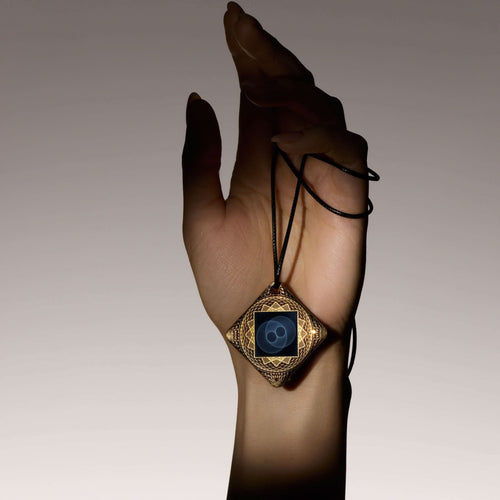
Exposure reduction changes the source, distance or time involved. The National Cancer Institute’s phone-radiation explainer describes how radiofrequency exposure varies with operating conditions and distance. Shielding uses materials to attenuate electromagnetic fields; its performance depends on frequency, construction and the tested arrangement. Aires structural field modulation uses a patterned semiconductor surface. Its research asks how that structure interacts with incident energy and how biological measurements change when the resonator is present.
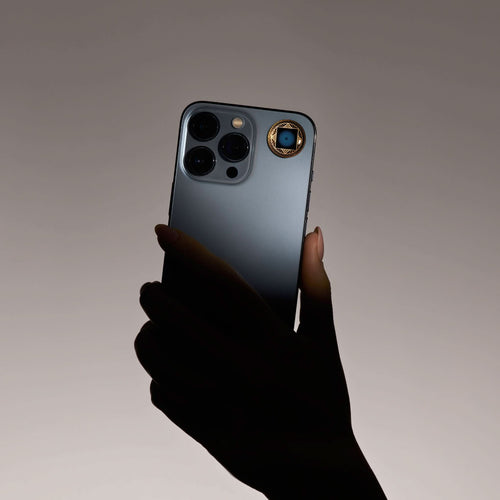
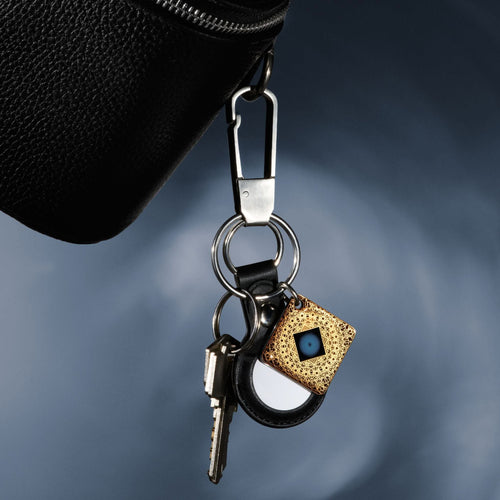
The modulation-versus-blocking guide explains these mechanisms. For a specific format, compare EMF stickers and resonators or phone neutralizers and their research.
The physical structure: from computation to experiment
Aires’ mechanism has a documented engineering history. Kopyltsov, Korshunov, Lukyanov and Serov’s 2016 paper models electromagnetic radiation interacting with a structured surface. Lukyanov, Kopyltsov and Serov’s Springer chapter develops semiconductor-wafer modeling around self-affine ring grooves.
The later 2026 ICICT publication by Lukyanov and Makarov adds a physical experiment. A Testo 890 infrared camera recorded a patterned silicon wafer during repeated heating and cooling. The patterned region produced a different apparent-temperature response from the polished region; the authors explain that contrast through emissivity and their charge-carrier model. Read the original thermal-imaging paper alongside the physics and engineering research hub.
Human EEG: a direct phone-with-and-without comparison
In Serov and Sysoev’s 2014 Aires Shield study, eleven men aged 18–22 completed GSM-900 phone conditions with and without Shield. Researchers recorded EEG across resting, standby, call, talk and recovery stages. They reported that phone-associated elevations in relative alpha- and delta-rhythm strength on the exposed side were largely absent with Shield, interpreting the result as a protective effect in that protocol.
The human research continued with Lifetune ONE. Sysoev and Budko’s 2026 peer-reviewed journal paper reports a return of EEG parameters toward background values after the initial response during phone use with the resonator, and changes in coherence after seven days of regular use. Follow the EEG study sequence for the original reports, publication history and researchers.
HRV: a measured autonomic response
Svetlana Datova’s 2013 report measured thirteen volunteers before and after twenty minutes with Aires Defender. The regulatory-system stress index decreased in twelve participants. The instrument’s cardiovascular-adaptation index rose from 42.2 to 55.7, a 13.5-percentage-point change in that functional score. Datova concluded that the observed autonomic changes supported an anti-stress and adaptive effect.
Andrew Michrowski’s 2018 PACE expert peer review assesses that experiment. The original measurements and the peer review are linked records with their own authors, dates and roles. The HRV research hub connects the findings to the wider autonomic-research program.
Connecting physics, biology and successive device generations
The program spans more than a single test. The 2018 rat chromosome study and the separate 2025 Pavlov Institute report on Lifetune Zone Max, Wi-Fi 6, behavior and blood extend the biological investigation. The research timeline connects those records with earlier cellular work, human physiology and later engineering publications.
This is the strength of Aires’ approach: a traceable research program across decades, with the physical structure and biological responses investigated through complementary methods. Each level contributes evidence to the central thesis of tuning the electromagnetic environment to support biological function.
How to choose a device using the evidence
- Identify your application: a phone, something you carry or a shared space.
- Match the named product and configuration to the original study.
- Read the measured endpoint and comparison condition, then the authors’ conclusion.
- Follow the product’s placement instructions for your intended setting.
Use the Lifetune product guide and product-specific research to connect your choice to the evidence. Explore the full Aires research overview for the broader program.
Explore the source-linked study summaries
2014 Aires Shield EEG investigation · 2026 Lifetune ONE journal publication · Datova’s HRV study and original results. These summaries connect the original papers, researchers and related evidence.
Updated October 26, 2026 · Josh, Aires. Original research is credited and linked to its authors.