Do EMF Stickers Really Work? What Physics and Independent Research Show
EMF stickers don't measurably reduce electromagnetic field exposure from your devices. No major regulatory body -- the FDA, FCC, or WHO -- certifies them, and no peer-reviewed study has demonstrated that an adhesive patch changes the RF emission profile of a wireless device. What 33 years of independent research does show is that structural modulation of the electromagnetic field -- not stickering, blocking, or shielding -- produces measurable biological effects.
Here's the physics behind why stickers can't work, why some metallic ones may actually make things worse, and what independent research from 13+ institutions across 6 countries shows actually does.
Why EMF Stickers Can't Work -- The Physics Problem
EMF fields from wireless devices are three-dimensional. A sticker is a flat surface. Even a conductive metallic sticker on one face of a phone can't intercept the field radiating in every direction from the antenna inside. Electromagnetic radiation doesn't travel in a single direction like a laser -- it propagates as a spherical wavefront.
For a sticker to actually block or neutralize EMF, it would need to completely enclose the antenna in a conductive shell -- a Faraday cage. That's a metal enclosure with no gaps, covering the device entirely. A small adhesive patch on the back of a phone doesn't approach that threshold. As a practical matter, you'd lose all signal if it did.
This physics constraint applies regardless of what material the sticker is made from: foil, copper film, "energy crystals," or printed circuits. None of these change how the field propagates through the air around the device.
The 3GPP Problem: Metallic Stickers May Increase Phone Output
A metallic sticker applied near a phone antenna may actually cause the phone to radiate more RF energy, not less. When a device's received signal quality drops -- as it can when a conductive object partially intercepts or reflects the signal -- the device's power control protocol automatically increases transmit power to maintain the connection.
This behavior is mandated by 3GPP standards, the technical specifications governing all modern cellular networks. It's called 3GPP power control compensation, and it exists to keep calls connected in weak-signal conditions. The result: a phone forced to work harder to maintain connection radiates more, not less. Partial shielding without complete Faraday enclosure can be a net force multiplier on field exposure, not a reduction.
This isn't an Aires claim -- it's documented telecommunications engineering. The same mechanism applies to shielding cases, Faraday pouches with gaps, and anything that degrades signal quality without fully enclosing the antenna.
What Regulators Have Actually Said
The FTC has taken enforcement action against companies selling EMF stickers for deceptive advertising. The FCC, which sets and tests device RF emission limits, does not recognize or certify any adhesive sticker product as an EMF reduction device. Neither does the WHO or FDA.
The FCC's position is straightforward: phones already must meet specific Specific Absorption Rate (SAR) limits before sale. No sticker changes those emission characteristics after the fact.
What Independent Research Shows Instead
The research question isn't whether stickers work -- mechanistically, they can't. The question is: what does modulate the biological response to EMF exposure?
Independent research from the Pavlov Institute of Physiology (Russian Academy of Sciences, IFRAN) has examined this across 20+ studies, including a 5-stage longitudinal rat program. One study from this program, Dyuzhikova et al. (2019, Ecological Genetics), is representative: in rats exposed to mobile phone EMF, chromosomal aberrations in bone marrow cells were 9.8% in the EMF-only group. With the Aires resonator present, that figure dropped to 2.7% -- statistically significant at p<0.001. Stickers weren't part of the study design because the research was examining whether field structure could be modified, not whether a passive adhesive patch could block a field.
A 2024 EEG study conducted at the Military Medical Academy (VMA, Russia) enrolled 24 human subjects and measured CNS bioelectric activity under mobile phone EMF exposure, with and without the Lifetune ONE device. The study documented normalized brain wave patterns in the Aires group -- a result that requires a mechanism, not a placebo.
The mechanism was confirmed computationally by Lukyanov, Kopyltsov and Serov at ITMO University, published in Springer (ICICT 2022, doi:10.1007/978-981-19-1607-6_7) -- the only Springer-published simulation of the Lifetune resonator's electromagnetic response. The simulation confirmed that the fractal circuit produces measurable modification of field structure around the resonator.
In total, the Aires research corpus spans 60+ independent studies from 13+ institutions across 6 countries, including cardiovascular testing (Dr. Magda Havas, Trent University, 2015, FDA Class II MaxPulse instrumentation), spectrum analysis from Vilnius Gediminas Technical University (VGTU, Lithuania, 2016-2018), and peer review by 7 independent experts coordinated through PACE (Planetary Association for Clean Energy, UN ECOSOC NGO status). None of this research involves EMF stickers. None of it involves blocking.
What Aires Does -- and Doesn't Do
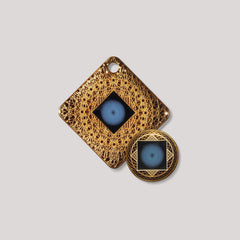
The Lifetune resonator doesn't block or eliminate EMF. It doesn't need to. Its mechanism is structural field modulation: a semiconductor wafer etched with a fractal-geometry circuit that modifies the coherence properties of the electromagnetic field in its vicinity. The goal is a more coherent field structure, not a weaker or absent one.
This is why Lifetune devices can operate on a phone without affecting signal strength, data speeds, or call quality -- they aren't intercepting or absorbing the field, only restructuring its coherence characteristics. The device continues to function normally. The field structure around it changes.
The technology is protected by US Patent US12239835B2, granted March 2025, covering operation across 2.4 to 28 GHz -- the frequency range that includes WiFi, 4G, and 5G signals.
EMF Sticker vs. Aires Lifetune: Side-by-Side
| Feature | EMF Sticker | Aires Lifetune |
|---|---|---|
| Mechanism | Passive adhesive or foil -- no active modulation | Fractal semiconductor -- structural field modulation |
| Independent studies | None documented in peer-reviewed literature | 60+ from 13+ institutions, 6 countries |
| Regulatory status | Not recognized by FDA, FCC, or WHO | US Patent US12239835B2 (2025); PACE peer review |
| Effect on device function | None -- may trigger 3GPP power increase | None -- connectivity and signal unchanged |
| Biological testing | No | EEG (VMA 2024), chromosomal (Dyuzhikova 2019), HRV (Havas 2015) |
| Frequency coverage | Unspecified | 2.4 to 28 GHz (WiFi, 4G, 5G) |
How to Evaluate Any EMF Product
If you're evaluating an EMF product, ask three questions. First: what's the mechanism? A sticker with no active structure can't modulate a field -- the physics don't support it. Second: what does independent research show? Not testimonials, not "as seen in" logos -- named studies from named institutions with named outcomes. Third: does the device affect device function? True EMF blocking would eliminate connectivity. If the product claims to block EMF and your phone still makes calls, the claim is inconsistent with itself.
For independent research on what structural field modulation shows in practice, see the Aires research overview and the EEG and brain research cluster. For a deeper look at the physics of why blocking approaches create problems, see Does EMF Blocking Work?
If you're looking for a device for personal protection -- for your phone, laptop, or other personal devices -- the Lifetune personal protection collection covers the range of options by device type and use case.
Frequently Asked Questions About EMF Stickers
Do EMF stickers really work?
No peer-reviewed study has shown that an adhesive EMF sticker measurably changes the RF emission profile of a wireless device. EMF propagates three-dimensionally from a device antenna, and a flat surface sticker can't intercept a spherical wavefront. No major regulatory body -- the FDA, FCC, or WHO -- certifies EMF stickers.
Can a metallic sticker reduce phone radiation?
A metallic sticker near a phone antenna can actually increase the phone's RF output. When a device's received signal quality drops due to a conductive object partially reflecting the signal, the device's power control protocol automatically increases transmit power to maintain the connection. This is called 3GPP power control compensation, mandated by the technical standards governing all cellular networks.
What do regulators say about EMF stickers?
The FTC has taken enforcement action against companies selling EMF stickers for deceptive advertising. The FCC does not certify any adhesive product as an EMF reduction device. The WHO and FDA do not recognize EMF sticker claims. Phones are already required to meet SAR emission limits before sale -- no sticker changes those characteristics after the fact.
What's the difference between an EMF sticker and the Aires Lifetune?
An EMF sticker is a passive adhesive patch with no active mechanism to modify a field. The Aires Lifetune is a semiconductor device with a fractal-geometry circuit that modifies the coherence properties of the electromagnetic field around it -- structural field modulation. The Lifetune is backed by 60+ independent studies from 13+ institutions and covered by US Patent US12239835B2.
Do any EMF stickers have clinical research behind them?
No clinical or peer-reviewed research has demonstrated that EMF stickers produce measurable changes in electromagnetic fields or biological outcomes. The research that exists on EMF field modulation -- EEG studies, chromosomal studies, cardiovascular studies -- involves active resonator devices, not adhesive patches.
Can EMF stickers interfere with my phone's signal?
A metallic sticker placed near a phone antenna can degrade signal quality and cause the phone to increase its transmit power via 3GPP power control compensation. If a product claiming to block EMF doesn't affect your signal, it isn't blocking the field.