
The Commute as a Daily EMF Concentration
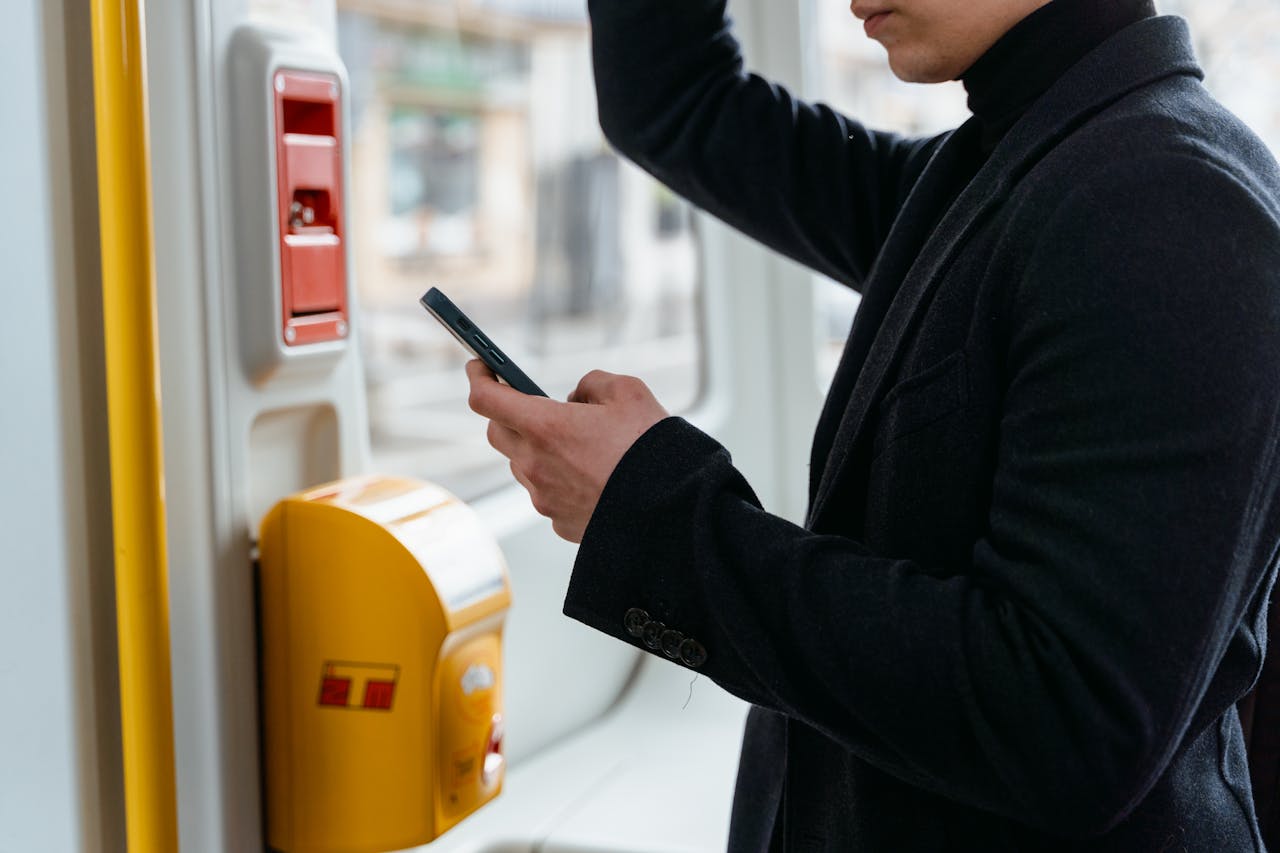
The daily commute is one of the most wireless-dense periods in a typical workday. Public transit systems deploy cellular amplification, Wi-Fi networks for passengers, and the combined radio emission of the transit vehicle’s own communications systems. Ride-shares and taxis have in-car Wi-Fi, cellular connectivity, and multiple occupants’ devices. Even solo car commutes involve persistent cellular connection, navigation app use, and often hands-free calling or Bluetooth audio — putting the phone in active use for extended periods at close range.
The commute typically lasts 30-90 minutes each way — an hour or more of concentrated wireless exposure at the bookends of a workday, on top of the exposure accumulated during the day itself. This is not a trivial fraction of total daily exposure.
Subway and Urban Transit: Peak Wireless Density
Subway cars have become among the most wireless-dense environments in urban life. Hundreds of commuters with active devices, plus cellular distribution antenna systems in tunnels pushing coverage through enclosed metal carriages, plus increasingly deployed onboard Wi-Fi systems — the RF environment in a rush-hour subway car is measurably dense. The enclosed metal environment also affects how RF fields propagate, creating complex reflection patterns that differ from open-air exposure.
Car Commutes: The Phone-in-Active-Use Problem
Solo car commutes are often the device-use scenario that biohackers and health-conscious people most overlook. The phone is used for navigation (screen-on, GPS active, cellular data active), entertainment (streaming or podcast apps), and often calls (Bluetooth active to the car’s hands-free system). The phone is typically positioned at dashboard or vent-mount level — within arm’s length for extended periods, in active-use transmission mode rather than standby.
Active transmission mode — when the phone is actively sending and receiving data — produces higher RF output than standby mode. A navigation or streaming app keeps the phone in a sustained active-transmission state for the duration of the commute.
Commute EMF Management: Practical Approaches
For subway and urban transit: wired earbuds instead of Bluetooth, phone in a bag rather than in hand or on lap, and a Lifetune Go wearable for continuous coherence modulation throughout the commute. For car commutes: download navigation offline before driving (reduces active cellular use), use Bluetooth audio but keep the phone physically farther from the body (dash mount at arm’s length rather than cup holder at thigh level), and apply a Lifetune device to the phone to address the primary source.
The 2024 VMA study (24 subjects) documented HRV improvements with Aires device use. The commute’s EMF environment is one of the most concentrated and least-managed of the daily exposure windows — and it precedes the work environment, meaning that the physiological state it creates sets the baseline for the day’s cognitive performance.
VMA Research Group (2024). EEG and ECG Assessment of Aires Device Effects. 24-subject trial.
Dyuzhikova, N.A. et al. (2019). Chromosomal Aberration Frequency study. p<0.001; 9.8%→2.7%.
Rybina, L. (2020). EEG Study of Brain Bioelectric Activity. 15-volunteer protocol.
IARC/WHO (2011). Radiofrequency Electromagnetic Fields — Group 2B classification.